
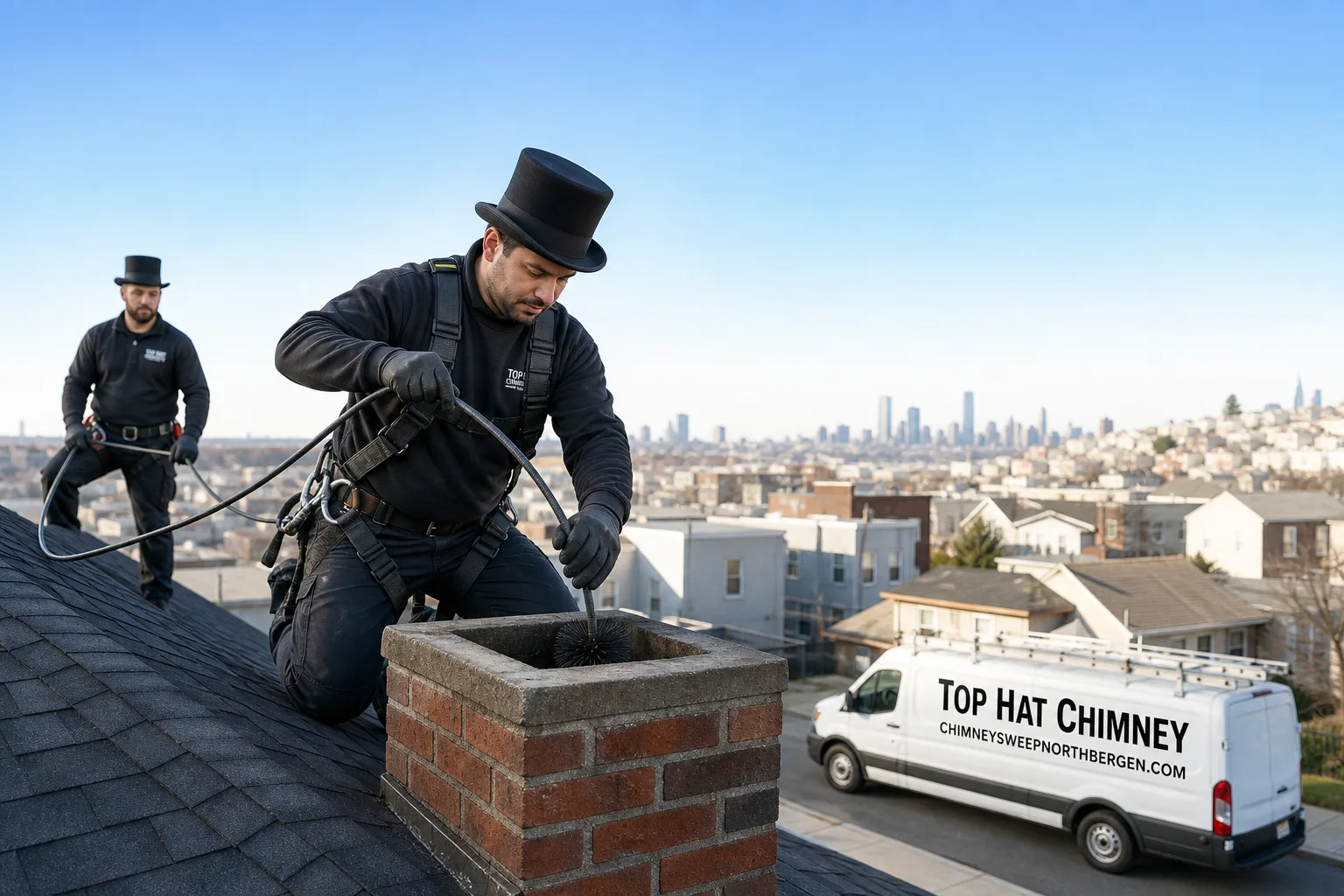
Level 1 sweep and inspection to the NFPA 211 annual standard - flue, crown, cap, and flashing checked and photographed
Chimney sweep logs do not sweep chimneys. They loosen some creosote - which then falls where a brush and vacuum still have to collect it.


 Before
 After
After Before
 After
After Before
 After
AfterFast, Reliable Chimney Liner & Rebuild Across West New York
Chimney liner replacement in West New York typically runs $2,800-$6,500 depending on flue height, building access, and whether you need a stainless steel retrofit or a full rebuild. Most jobs take one to two days once materials are on site. If you own or manage a pre-war brick building on the Palisades, the odds are good your flue was never designed for the boiler now venting into it. Call (848) 361-3227 and we’ll scope it with a camera before quoting anything.
West New York’s chimneys are different from what you’ll find ten minutes inland. The housing stock here is almost entirely multi-story brick apartment and tenement buildings from before 1960. Shared stacks, multiple boiler flues, landlord-tenant coordination, and rooftop wind exposure that doesn’t exist in flatter parts of Hudson County. Wendell Pike and his crew have worked these buildings, pulled permits for these jobs, and stood on these rooftops with a camera in hand. We know what we’re looking at before we quote it.
Why Top Hat Chimney Is West New York’s Preferred Chimney Liner & Rebuild Company
We’ve been doing this since 1999, and around here that matters. Not because “experience” sounds nice on a website, but because West New York’s building stock throws curveballs a franchise tech won’t recognize. A shared three-flue stack on a 60th Street tenement is not the same job as a single-flue fireplace in a suburban colonial. Wendell’s been inside enough of these to tell you what’s actually wrong, and just as often, what isn’t.
Every job we finish carries the 90-Day Done Right Promise in writing. If the liner isn’t right, if the crown cracks again, if the draft still back-puffs on a windy March afternoon, one call brings Wendell back. That’s not a slogan. It’s stamped on your invoice. We answer the phone around the clock with a live person, and it may well be Wendell himself picking up at 2 a.m. when a tenant reports fumes.
We don’t do bait pricing. The number you hear on the phone is the number on the invoice. Before a single tool comes off the truck, you get the cost in writing. And we never recommend a liner or rebuild without camera footage you can watch yourself. If the flue is fine, we’ll tell you it’s fine and bill you for the scope. That’s how a neighbor does business.
Top Hat Chimney is locally owned and owner-operated. Wendell puts his name on the work, publishes his license number, and will run into you again at the grocery store on Bergenline Avenue. That’s the difference between us and a national outfit that rotates through a different crew every season.
Our Chimney Liner & Rebuild Services in West New York
Stainless Steel Liner
Most of our West New York liner work is stainless steel retrofits into existing masonry stacks. Buildings that converted from oil to gas often have clay tile flues that were sized for hotter oil exhaust. Gas burns cooler and wetter. The condensate eats clay from the inside. A properly sized DuraFlex or Copperfield stainless liner stops that. We size the liner to the appliance, not to whatever fits, because an oversized liner cools the exhaust too much and creates the same acid problem you were trying to fix.

Flexible Liner
Flexible liners make sense in West New York because the stacks are rarely straight. Decades of settling, terra cotta offset, and the Palisades’ wind-driven thermal cycling have left most flues with bends a rigid pipe can’t follow. A flexible stainless liner snakes through those offsets without major demolition. We use it where the flue path allows, and we’re honest when it doesn’t. Flex isn’t right for every job, and we’ll show you why on camera if a rigid or hybrid option fits better.

Liner Replacement
When the old clay tile liner is spalled, cracked, or glazed with third-degree creosote, replacement is the only fix that actually fixes it. We see a lot of this in West New York buildings that passed visual inspections years ago but were never scoped internally. The flue looks fine from the roof. The camera tells a different story. Liner replacement in a shared stack means coordinating with the building owner and sometimes juggling access across multiple units. We handle that. Wendell’s crew does this regularly, and we’ll pull permits and keep the job moving so tenants aren’t left without heat longer than necessary.

Partial Rebuild
Not every chimney needs to come down to the roofline. A partial rebuild addresses the top courses of brick, the crown, and the flue liner above the roof deck. This is common in West New York because Palisades wind loading hits the crown hardest. Unobstructed westerly winds push up the escarpment and attack the top few feet of the stack. A partial rebuild with a new cast-in-place crown and proper flashing stops the water intrusion before it reaches the units below. It’s also a fraction of the cost of a full rebuild, and we’ll tell you plainly when partial is enough.

Full Chimney Rebuild
When the masonry itself is beyond saving, a full rebuild is the answer. We take the stack down to the roof line or further, relay the brick, install a new liner, pour a new crown, and flash it correctly. In West New York’s tenement buildings, full rebuilds usually involve coordinating with the landlord, tenants in every unit, and sometimes the building department. We’ve done it. The job takes longer and costs more, but a rebuilt stack with a proper liner is a 40-year fix, not a three-year patch.

What happens when you call
- 1
A real person answersNo phone trees - you reach a local pro.
- 2
You get an upfront price rangeHonest numbers before anyone is dispatched.
- 3
A background-checked tech heads outLicensed & insured, dispatched right away.
- 4
You approve before work beginsNothing starts until you say go.
Trusted Brands We Service in West New York
We install and service liners from DuraFlex, Copperfield, and HeatShield, and we stock common components locally so West New York jobs don’t stall waiting on a truck from out of state. DuraFlex stainless liners are our workhorse for oil-to-gas retrofit work in multi-unit buildings. Copperfield offers a heavier-gauge option for stacks that take serious weather exposure up on the Palisades. HeatShield is a ceramic resurfacing system that can restore a clay tile liner when a full stainless retrofit isn’t necessary. We’ll make a brand recommendation based on what the camera shows, your boiler’s output, and the specific draft conditions we measure on your roof. You’ll always know why we picked what we picked.
Common Chimney Liner & Rebuild Problems We See in West New York Homes
- Acidic condensate from oil-to-gas conversions. Gas exhaust is cooler and wetter than oil exhaust. Inside an old clay tile flue, that moisture condenses into acidic liquid that eats the tile from the inside out. You won’t see it from the roof. The camera will.
- Palisades wind loading on crowns and top courses. West winds sweeping up the escarpment hit rooftop chimneys with force you don’t get in North Bergen or Secaucus. We see cracked crowns, spalled brick, and eroded mortar joints at a rate that matches the exposure, not the building’s age.
- Multi-flue draft imbalance during liner work. When one flue in a shared stack gets relined, the draft dynamics of the whole stack shift. Skip the balancing step and you get downdrafts in the neighboring flues. That’s how a “successful” liner job turns into tenant complaints about smoke pushback in the unit next door.
- Undetected clay tile failure after a passing visual inspection. A visual inspection checks what you can see from the roof and the firebox. It doesn’t see the cracks mid-flue. We scope every job with a camera before recommending anything, and we show you the footage. If the liner failed, you’ll see it with your own eyes.
Pricing for Chimney Liner & Rebuild in West New York, NJ
A stainless steel liner retrofit in West New York typically runs $2,800-$4,800 for a single-flue installation in a two-to-three-story building. Multi-flue stacks, taller buildings, and difficult rooftop access push that to $5,000-$6,500. A partial rebuild, including a new cast-in-place crown and top-course masonry repair, generally falls between $2,500-$6,000. A full chimney rebuild for a Palisades townhouse or tenement starts around $6,000 and can reach $15,000+ depending on stack height, brick condition, and whether we’re working around occupied units. These are real ranges for this market, not call-to-find-out placeholder numbers.
We offer a free second opinion on any written estimate you’ve received from another company, and seniors and veterans always get 10% off. If the repair is over $200, you get $40 off. Call (848) 361-3227 and we’ll schedule a scope. You’ll know the cost before we touch a brick.
We Also Serve Cities Near West New York
Our Chimney Liner & Rebuild team works throughout northern Hudson County. If you own or manage a building in North Bergen, Union City, Secaucus, or Weehawken, give us a call. We coordinate scheduling and dispatching from our New York City office, and crews reach West New York and the surrounding communities quickly, usually within a day or two of your call.
Serving West New York, NJ - Our Local Coverage Area
We’re based in the West New York area and know this community well. Use the map below to see our service coverage - if you’re nearby, we can almost certainly help.
FAQs - Chimney Liner & Rebuild in West New York
In most cases, yes. Gas exhaust is cooler and wetter than oil exhaust, which means acidic condensate forms inside a flue sized for hotter oil combustion. That acid destroys clay tile liners from the inside. NJ code requires properly sized stainless steel liner retrofits for many oil-to-gas conversions, and a lot of West New York buildings never had the work done. If you’re not sure whether your building is compliant, call (848) 361-3227 and we’ll scope it with a camera. You’ll see the condition of the flue for yourself before anyone recommends spending money.
That’s classic Palisades wind loading. Strong westerly and southwesterly winds push up the escarpment and create negative pressure at the chimney cap, which reverses the draft and pushes exhaust back down the flue. Cracked crowns, spalled mortar joints, and improper liner sizing all make it worse. In many West New York buildings, the fix is a properly sized stainless liner and a crown rebuilt to handle the wind exposure. If you’re getting complaints only when the wind blows, that’s not a tenant being difficult. It’s a draft problem, and it’s fixable. Call us for a scope and we’ll show you exactly what the wind is doing to your stack.
We treat a shared stack as a system, not as independent flues. Before we break anything, we scope every flue in the stack and measure draft on each one. Then we plan the rebuild so the relined flue doesn’t steal draft from the others. In multi-flue tenement buildings, we coordinate with the landlord and tenants across all affected units, pull permits, and schedule the work to minimize downtime. We also run draft tests after the job to confirm the balance held. If one flue’s draft is off, the whole building feels it. We don’t leave until all of them are right.
A partial rebuild addresses the top few feet of the stack: the crown, the top courses of brick, and the flue liner above the roof line. A full rebuild tears the stack down to the roof deck or below and rebuilds it entirely. For most West New York townhouses, partial is enough unless the masonry is structurally compromised or the liner has failed across the full height. The camera tells us which one you need. If the lower masonry is solid and only the crown and top courses are spalled from Palisades wind, partial saves you thousands. If the stack is leaning, cracked through, or pulling away from the roofline, full is the only honest answer. Call (848) 361-3227 and we’ll scope it.
Most inspections are visual. A visual inspection checks what the inspector can see from the roof and the firebox. It doesn’t see the middle of the flue. Cracked liners, spalled clay tiles, and creosote glaze hide in the middle third of the stack where no one looks. We scope every flue with a camera before making recommendations. That’s why we find liner damage in buildings that “passed” a year or two ago. The damage was there. Nobody looked. If you want to know what’s actually inside your flue, we’ll show you the footage, not a checkbox. Call (848) 361-3227 for a scope and a plain-English verdict.
Call Top Hat Chimney for Liner & Rebuild Work in West New York
If you own or manage a building in West New York, your chimney stack is working against the Palisades wind, the Hudson’s humidity, and the ghost of an oil-to-gas conversion that may have left the flue eating itself from the inside. You don’t need a sales pitch. You need a camera, a straight answer, and a number you can trust. That’s what we do. Call (848) 361-3227 for a free estimate. Wendell or a member of his crew will answer, and if the job doesn’t need doing, we’ll tell you that too.
Written by Wendell Pike, Owner at Top Hat Chimney, serving West New York with chimney liner and rebuild work since 1999.